Home / How we organise
How We Govern Ourselves
Membership, consent decisions, the steward circle, the board, and commonising the buildings.
Last updated 17 Aug 2026
The Foundry is a self-organised, non-profit association. It was founded as a project in 2018 and registered as an association in 2020, and it is currently in the middle of the most significant change in its short life: moving from being carried by its founder to being run collectively, and moving the buildings themselves from private ownership into a commons.
This page describes how decisions are actually made here. It is written down because self-organisation that only exists in people's heads is not self-organisation — it is an informal hierarchy waiting to be discovered.
Three commitments
The project has rested on the same three things since 2018:
Openness. Anyone who wants to come can come. No complicated application procedure stands between a person and the place.
Self-organisation. Maintenance and organisation are done by the people who use the space, not by paid staff.
No profit. The Foundry is a non-profit association. Nobody can extract money from it. It was conceived as a piece of counter-infrastructure — a place at the edge of state and market.
Membership
Everyone who stays overnight or organises an event becomes a member. There are now more than a hundred.
Becoming a member means reading the statutes, filling in the membership form, and paying €20 a year. Members vote at the general assembly regardless of which role they hold.
Roles carry different responsibilities rather than different status:
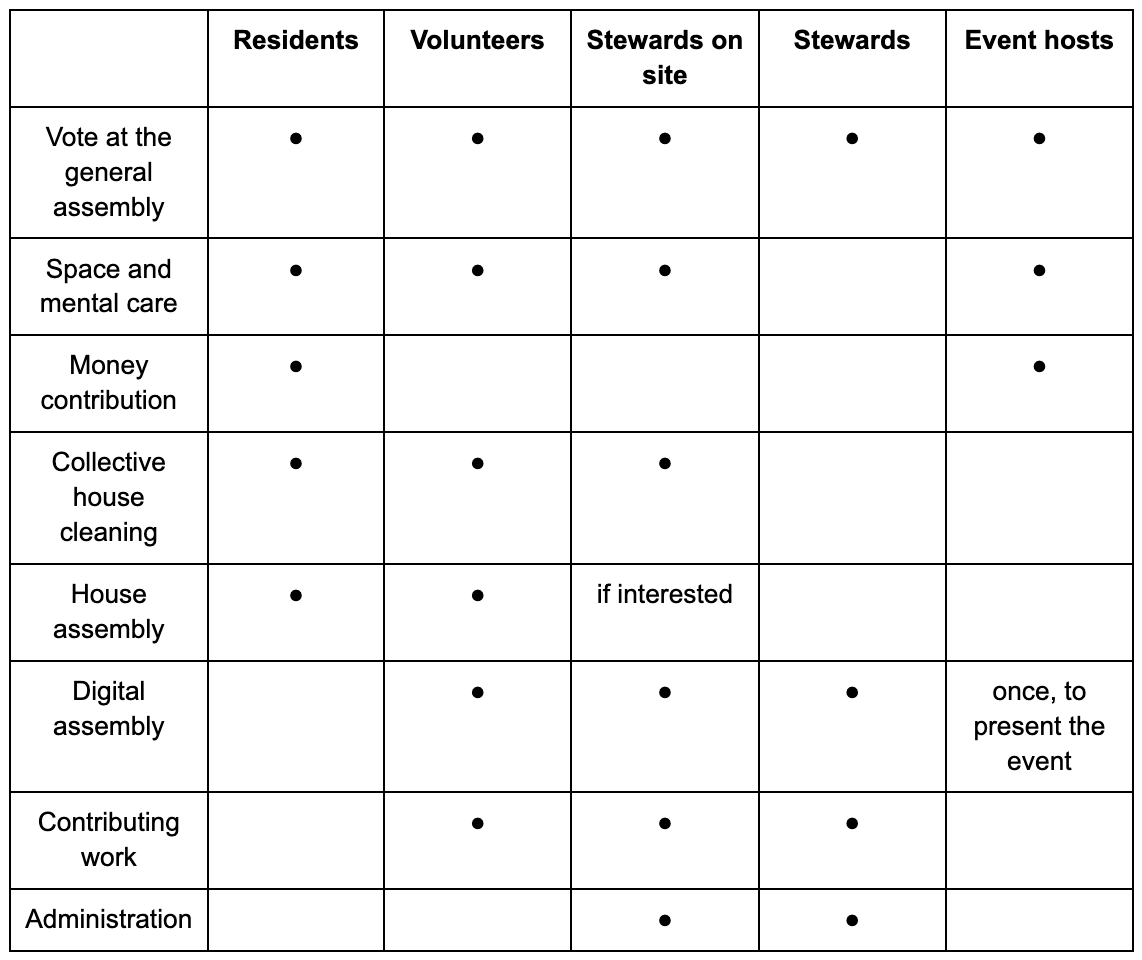
Full details of hours, durations and contributions are in the house manual, which every new arrival is given. See the Volunteering and Stays for the summary.
How decisions get made
We aim for consent — a proposal passes when there are no major objections, rather than requiring everyone's active enthusiasm. Any member can write a proposal.
Decisions happen at three levels, and knowing which is which saves a great deal of frustration:
- House assembly, weekly, coordinated by the steward/s on site. Day-to-day organisation: space use, events, cleaning, kitchen, volunteer work.
- Digital assembly, every two weeks, coordinated by the steward circle. Coordination across everyone who is not physically here.
- General assembly, every two months, with two weeks' notice to all members. Everything that is not daily coordination.
Meetings use explicit roles, which sounds bureaucratic and is the opposite — they stop the same two people running everything by default:
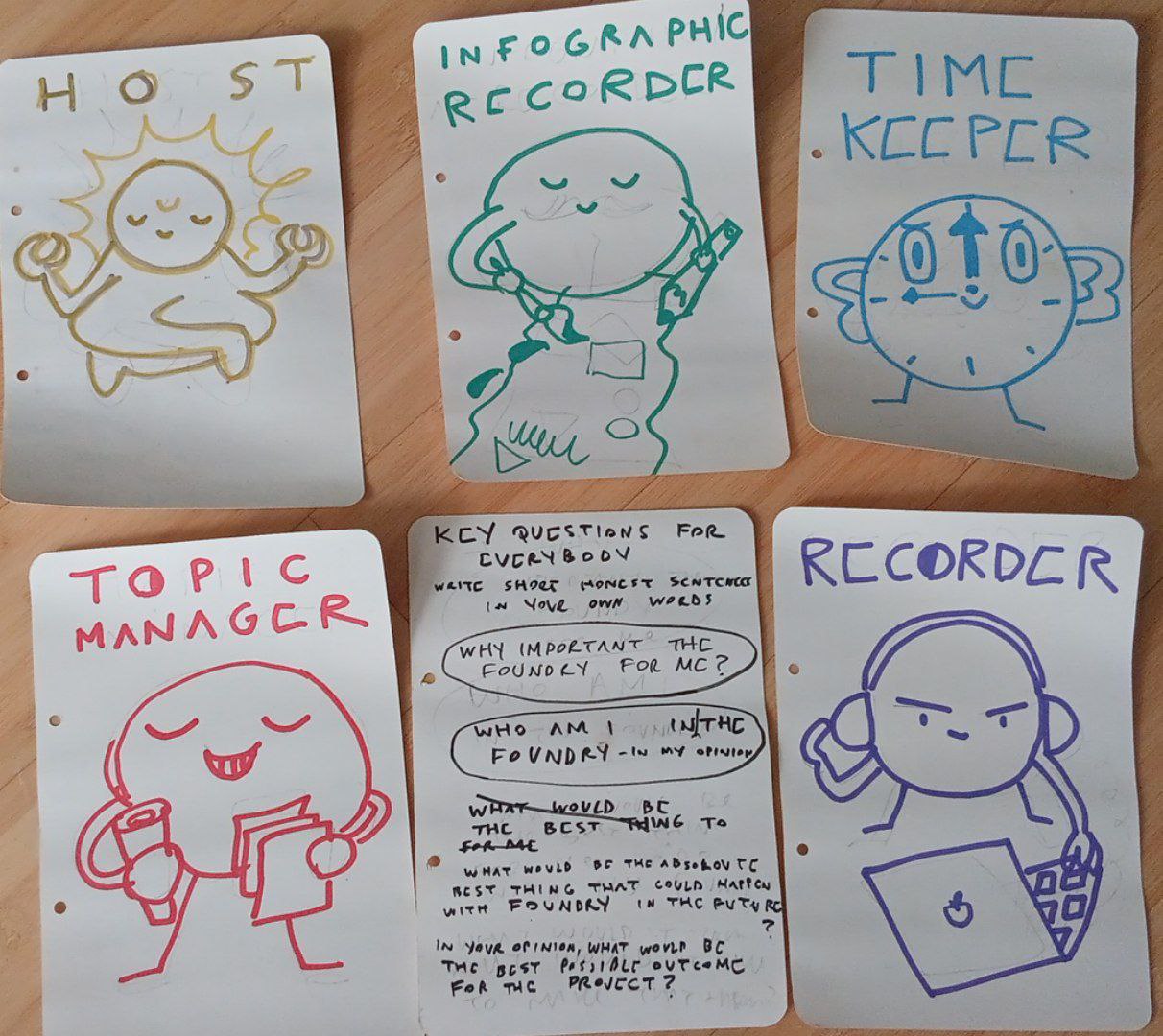
A host, a timekeeper, a topic manager, a recorder, and an infographic recorder who draws what is being said. Rotating these is a small practice with a large effect on who feels able to speak.
How we arrived at this
How we arrived at this The current shape is the third attempt, and the earlier two are worth recording. A general assembly once agreed to an elaborate horizontal decision-making process intended to spread power through the year; the working groups it created had mostly dissolved within months, and the year that followed was marked by tension between residents and members who were not here.
What emerged from that failure was a rougher principle: the doer decides — those who put in the time carry the weight of the decision — while anything that changes the place structurally needs the consent of the wider group. Consent decision-making is what we practise now, but it sits on top of that history rather than replacing it. The recurring difficulty is not disagreement; it is continuity. People arrive, carry something, and leave, and what they knew leaves with them.
The steward circle
Between assemblies, continuity is held by the steward circle. The aim is ten to twelve active stewards, with one or two on site at any moment — enough that no single person's departure or exhaustion stops the place functioning.
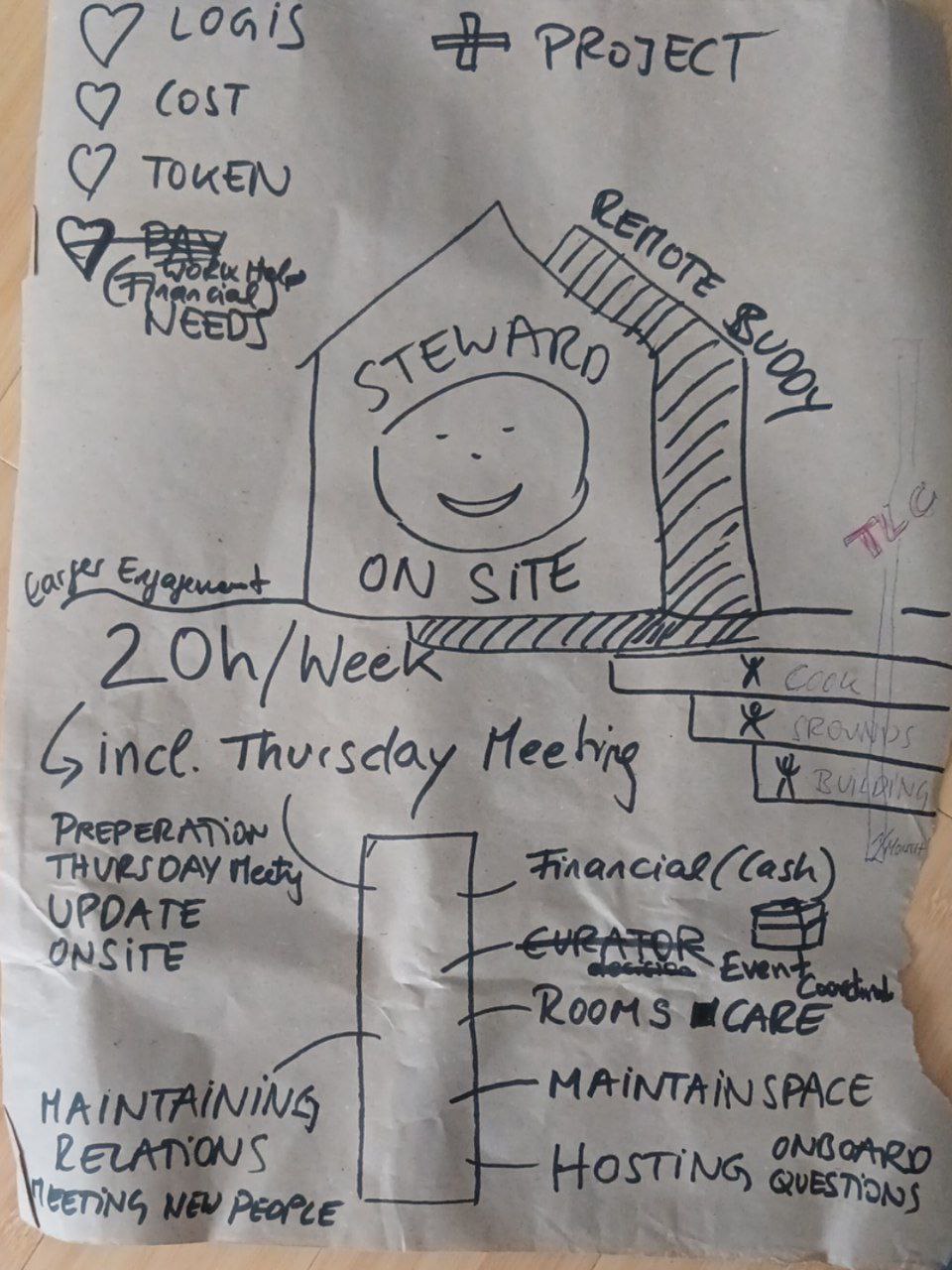
What being a steward on site actually involves was mapped out collectively: around twenty hours a week covering the Thursday meeting and its preparation, welcoming residents and preparing rooms, facilitating cleaning, finances and cash, event coordination, maintaining relationships with neighbours, and being the person who answers when something breaks.
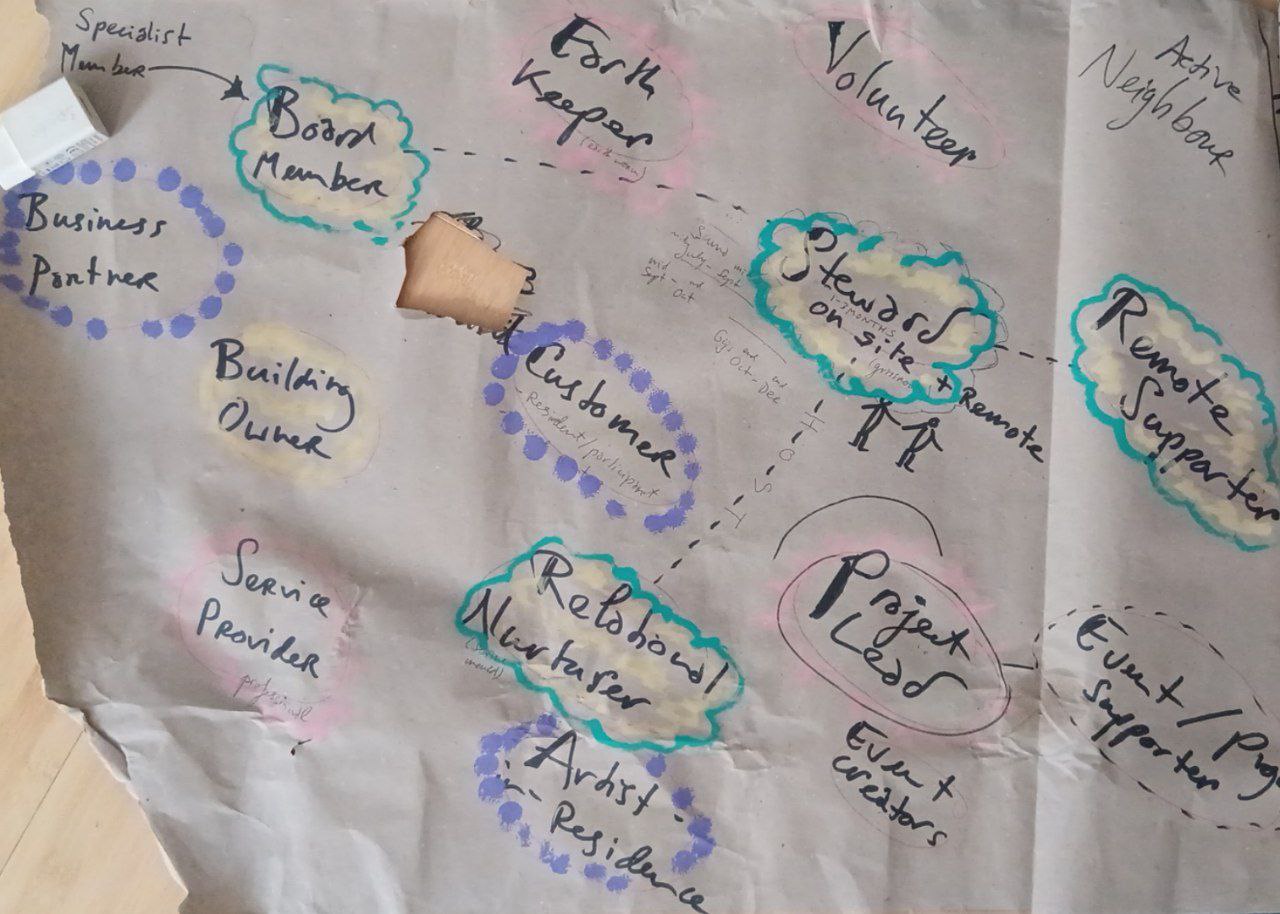
The same exercise mapped everyone who has a stake in the place — board members, volunteers, artists in residence, event hosts, remote supporters, neighbours, service providers, the building's owner — which made visible how many different relationships the association is actually holding.
Stewards have a buddy in the circle, monthly checkpoints, and a logbook whose explicit purpose is protecting people's free time and preventing burnout.
The board
Spanish law requires an association to have a xunta directiva — president, secretary, treasurer. This exists as the interface with the state, banks and public administration.
Internally, we do not organise ourselves around those titles. The president does not decide things because they are president; the treasurer is not the only person who thinks about money. The paperwork requires a hierarchy and we supply one; the work is distributed differently.
Two things about the board are worth stating plainly rather than discovering later. There is real legal liability, particularly for the president: the building is used as a public space but is not certified as one, which is managed by it being a private space for members of the association. The risk is small and comparable spaces have operated this way for decades, but anyone joining the board should understand it. And board changes are slow — every outgoing and incoming member must sign, identity documents must be attached, and the change must be filed with the Xunta de Galicia before banks and grant portals will recognise it.
Commonising the buildings
The property is still privately owned. The owner and the association are working to transfer it, and the intention is that once transferred the house will be asset-locked — never able to become private property again. The mechanism is Futuro Habitable (futurohabitable.es), a legal structure modelled on the German Mietshäuser Syndikat and built with lawyers in Galicia. It works by splitting ownership: a limited company holds the building, and that company has two owners, each with half — the association of the people who use the place, and Futuro Habitable itself.
Everything about daily life is decided by the users. The one decision they cannot take alone is to sell, because it needs both owners to agree, and the sole purpose of Futuro Habitable is to refuse. The incentives never align, so the sale never happens. Draft statutes carrying the lock were circulated to members in July 2026 and are open for comment. Two things have to come first.
- The association needs to be socially sustainable for a few years — a place that cannot hold a steward circle together cannot hold a building.
- It needs capital, because transferring property attracts tax calculated on the value of the building rather than on what is paid for it.
One feature of the new statutes deserves stating plainly: they are designed to be almost impossible to change afterwards. That is the point. If a simple majority could amend them, a future assembly could remove the asset lock, and the protection would be worth nothing. So they need to be right before they are adopted, which is why professional legal advice is still being sought rather than rushed. This is why questions that look practical are also constitutional. Who pays for a chimney, who signs a grant, who holds the bank account: each one is a question about whether the association is yet capable of stewarding the place. See Funding and The Building.
A phrase from Massia, a partner project in Estonia, has stuck with us as the plainest statement of the goal:
The core group does not own the place; they simply stand in to help it thrive.
What we are aiming at
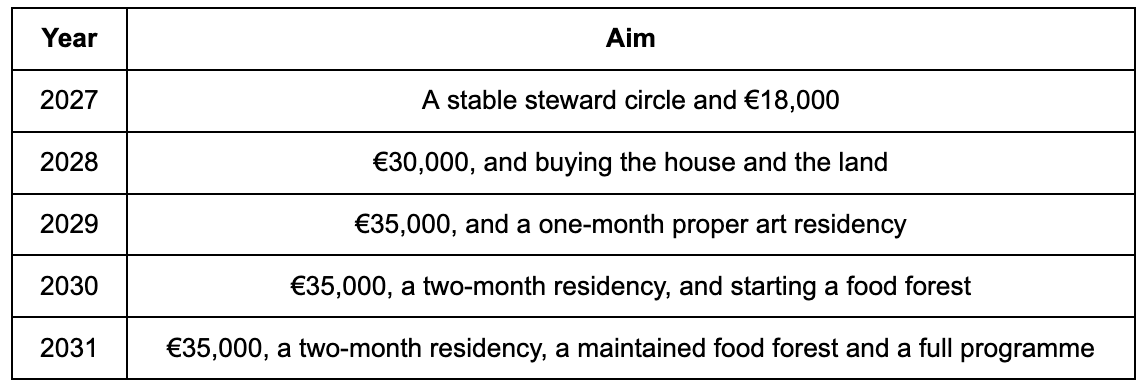
For context, the bare minimum to keep the association and house existing is around €18,000 a year — heating, water, electricity, internet, small repairs, renovation, food for two stewards on site — with roughly €12,000 more needed to function sustainably rather than merely survive. Any surplus is allocated by the general assembly: buffer, investment, materials, projects, or a solidarity fund.
Living together
Self-organisation is mostly relationship work, and the association has been building explicit structures for it rather than hoping goodwill scales.
Mental cleaning happens weekly alongside the physical cleaning — an hour facilitated by the steward on site, for friction within the group. The name is deliberate: it treats relational maintenance as ordinary upkeep, like emptying the compost.
Conflict has a documented process. Note the situation in writing; speak directly to the person; bring it to mental cleaning; speak to the steward on site; bring it to the steward circle; and if urgent, call the conflict hotline or request an urgent meeting. Decisions to ask someone to leave are made by the steward circle, and the person receives a written explanation with a date.
The conversation framework used in these sessions is three questions, with three ground rules:
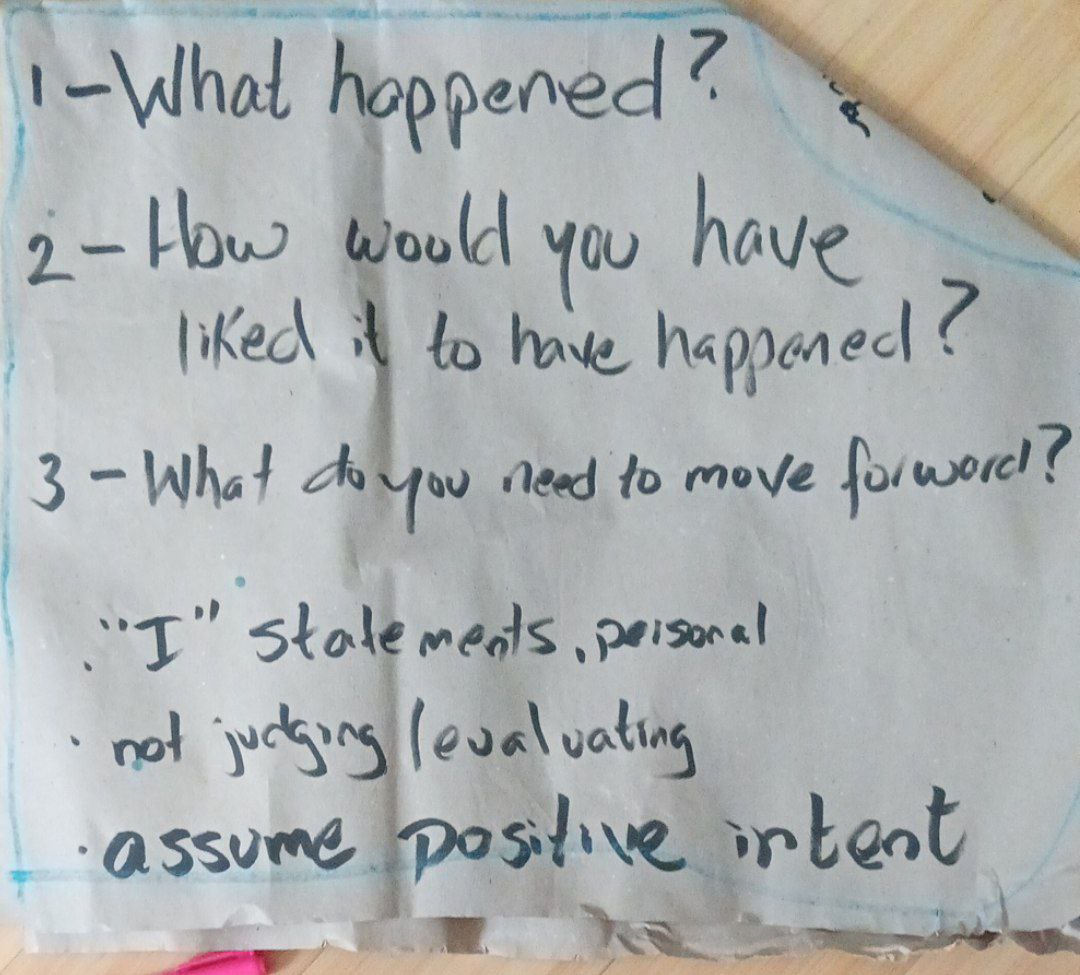
Boundaries are named. Touching without consent, dominating behaviour that does not listen, and spontaneous heavy drinking or substance use in shared space are all explicitly out of bounds. Violations of personal boundaries are never tolerated.
At the general assembly of May 2026, members passed proposals establishing a conflict hotline working group and a co-existing and boundaries working group. The second was proposed with unusual honesty: earlier attempts to establish clear rules around gender-based violence and processes for handling violations had failed, and the group's task is to find out why, look at how other places do it, and produce something that works.
Assemblies in the open
Proposals passed at a general assembly are circulated to all members in full, in English and Spanish, with the outcome of each. Minutes are published on the blog. Disagreements that were not resolved — the recurring argument about whether room prices are too high, for instance — are reported as unresolved rather than smoothed over.
Recent decisions include a system of advance stay vouchers, the two working groups above, and a tiered contribution from commercially organised events. See the Getting the Word Out section for how these get communicated.
What we read
The transition has been accompanied by reading rather than improvised. Sources that have shaped the current structure:
- Miki Kashtan on decision-making systems, moving from either/or to integration, and the advice process in particular
- Taking Power Back, Nesta — https://www.nesta.org.uk/report/taking-power-back/
- Coordi-nations, on institutional structures for cooperation beyond the nation state — https://jessykate.medium.com/coordi-nations-a-new-institutional-structure-for-global-cooperation-3ef38d6e2cfa
- Murky Waters, PAF's own proposal for self-organising through mandate and trust rather than formal equality — discussed at length in the reading circle
- Mutual credit and asset models for moving property out of speculative markets — https://www.mutualcredit.services/use-credit-obligations
Taking part in it
If you have capacity and an interest in how this place is run, join a digital assembly and meet the steward circle. Write to foundry@bravosfoundry.com for the link.
The honest invitation is this: the structures on this page are two years old, visibly unfinished, and being tested against a real building with real bills. That is what makes them worth joining.