Home / Land and place
Land Care
The huerta, the food forest, eucalyptus and mushrooms, and the open question of how this land should be kept.
Last updated 17 Aug 2026
The Foundry sits on a stretch of Galician land with a river running through it, a church, a campsite, houses, and a good deal of ground that has been left to itself for years. Looking after it is the most continuous work the association does, and the one where the difference between an idea and a season's labour shows up fastest.
This page describes what is on the land, what we have tried, what we have learned from neighbours, and the questions we have not settled.
The huerta
The vegetable garden is the part of the land in steady production. Beds are made and worked by hand — when a neighbour offered to pass a tractor through the huerta in spring 2025, we declined, on the reasoning that tilling breaks the soil structure that makes the beds work in the first place. The small huerta needs no tractor, and the beds we had already made were proof.
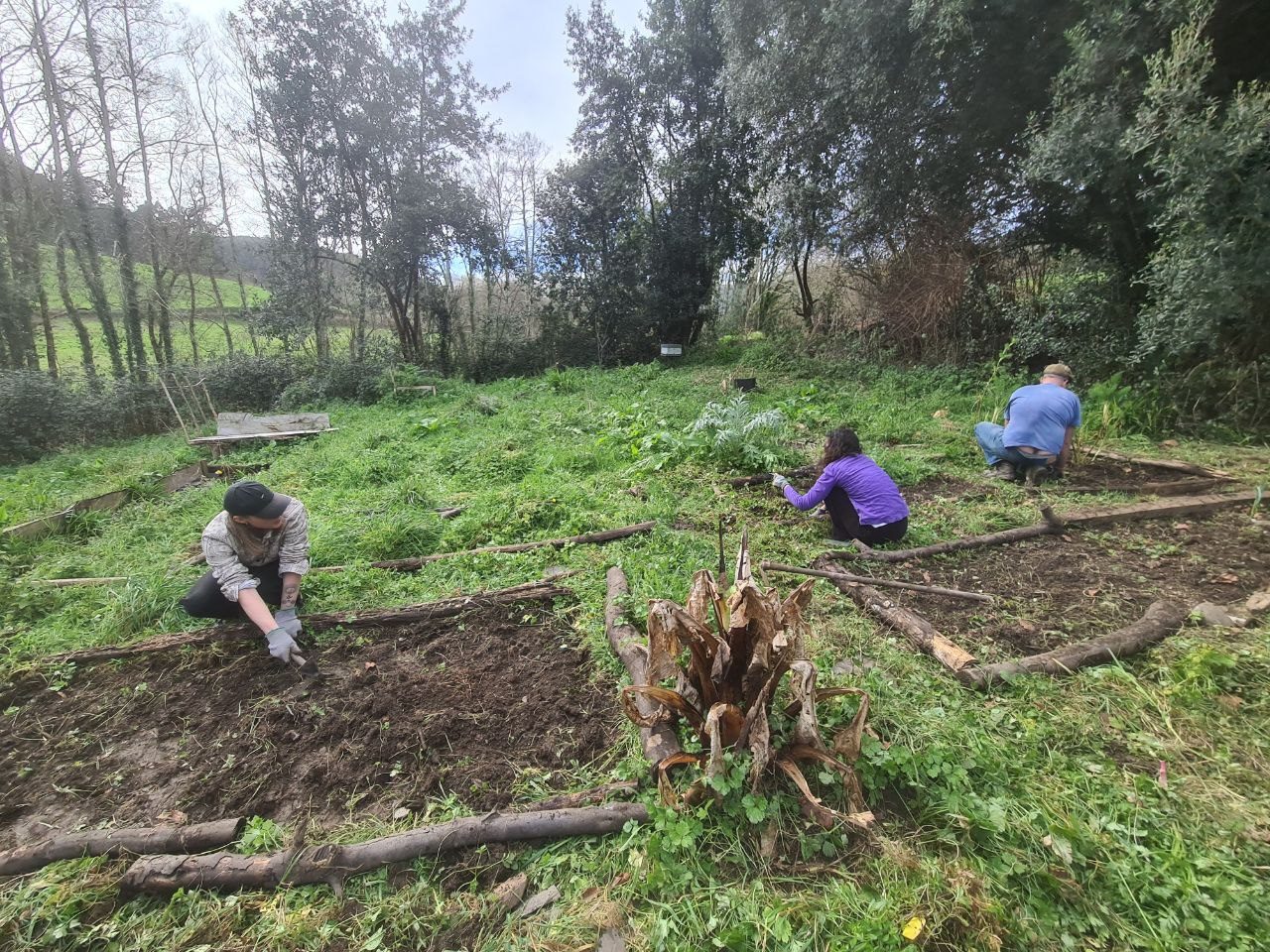
By March the first greens are up, and by then the beds are doing what beds do: holding moisture, suppressing what we do not want, and making the work of weeding small enough to be done in passing.
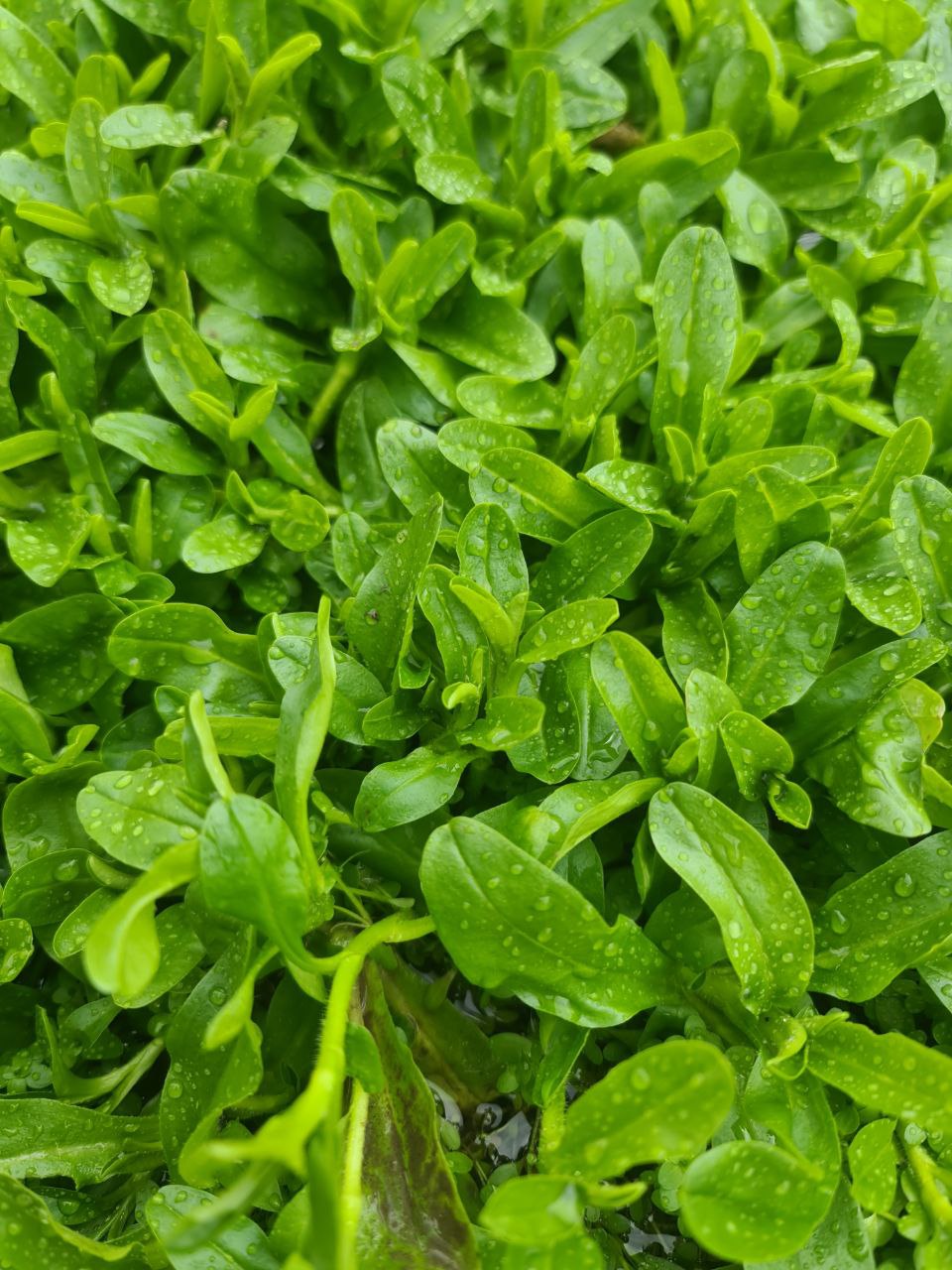
Work days bring more than vegetables. In one long March weekend the heating system was repaired, a large quantity of firewood was cut, brambles were cleared, seeds were swapped and contacts exchanged between people who had not met before. This is the ordinary rhythm of the place: a few concentrated days do what months of individual effort would not.
Composting
Our compost is slow by design, and that changes the usual advice. Neighbours warn against putting citrus in a compost heap, on the grounds that the acidity harms the microorganisms and mites doing the work. That is sound advice for a heap you want finished quickly. Ours is never full and never in a hurry, so citrus goes in and simply takes longer to break down.
The food forest
Beside the bus there is a food forest, started by Ana of Proxecto Dispersor, a Galician agroforestry project that designs regenerative plantings and makes its own hand tools for the work — including the Pluma, a planting tool designed to open a nest for a seed or a cutting with minimal disturbance to the roots already in the soil (https://projectodispersor.com).
There are roughly twenty-five fruit trees in the food forest itself, and perhaps twenty more planted in other spots around the land.
One open task: we have never written down a species list. Anyone who knows what is planted where is asked to add it — a food forest that only exists in one person's memory is fragile, and the list is the difference between stewardship and guesswork.
The longer-term idea is a planting brigade: a day when enough people come to plant a hectare at once, prepared in advance and designed together with whoever started the planting. That has not happened yet.
Eucalyptus
Galicia has over 430,000 hectares of eucalyptus, roughly a third of all the eucalyptus on the Iberian Peninsula. It grows fast, it is bought by the pulp industry, and it has reshaped both the ecology and the economy of the Galician monte. On our land it is simply present, in quantity.
There is a long echo here. This place made iron for three centuries and stopped twice for the same reason — the forest around it had been cut down for charcoal, first by the 1720s and again by 1788, when a legal appeal cited Bravos as proof that the industry was unsustainable. The land was ruined by what was taken out of it, and the association now spends its weekends taking out a tree that was planted for the same kind of industry. See the Timeline.
Our working position is straightforward: on Foundry land, eucalyptus can be cut. Where there is doubt about whether a parcel is Foundry land, ask first. Trees at the waterside are left alone.
The wider fight
Two campaigns have run alongside this work and both matter to how the land is understood.
Altri. A Portuguese company proposed an enormous cellulose and textile fibre plant at Palas de Rei, in the geographic centre of Galicia, next to a Natura 2000 protected area, drawing water from the Ulla. It drew some of the largest demonstrations in Galician history and more than 23,000 formal objections, organised largely by the Plataforma Ulloa Viva. In June 2025 the association shared their crowdfunding campaign for the legal challenge. The Xunta began archiving the project in February 2026 for lack of a guaranteed electricity connection, and in July 2026 communicated the definitive archiving of the file, calling the project unviable as proposed. Ulloa Viva's response was measured: relief, caution, and some anger that it took a missing electrical substation rather than the impact on people and water. Their campaign: https://gl.goteo.org/project/altri-non-por-un-rural-galego-vivo-alegre-digno-e-
Celulosas fóra. The APDR and PDRA call an annual march against the pulp mills; the association joined the mobilisation in Pontevedra in June 2025 under the slogan against ENCE in the ría and Altri in the Ulloa.
Brigadas Deseucaliptizadoras
The model we look to for the work itself started in the community of Froxán, in Lousame, and was set going by the environmental collective Verdegaia in 2017. It is built on two traditional Galician practices: the roga, a call to collective work, and the albaroque, the shared meal and exchange that follows it. A morning is spent felling eucalyptus and acacia, ring-barking and stripping regrowth, and planting native broadleaves; the afternoon is lunch, conversation, sometimes music.
It has grown into something substantial — hundreds of volunteers a year across many parishes — and its lesson is organisational as much as ecological: the albaroque is not a reward bolted onto the work, it is what makes people come back. Convocations and how to join: https://verdegaia.org/brigadas/
Mushrooms from eucalyptus
Rather than treating felled eucalyptus as waste, we have been trying to turn it into food. The idea is deceptively simple — inoculate the logs with mycelium and harvest mushrooms — but eucalyptus is a difficult substrate. Most cultivation guides explicitly advise against aromatic woods, because the volatile oils that make eucalyptus smell like eucalyptus also inhibit fungal growth.
So the work has been about preparation. Logs cut in spring 2025 were left about two months to dry, then soaked and leached in the river for around three weeks before inoculation, with different soaking times tried against each other to see what the wood needs before mycelium will take.
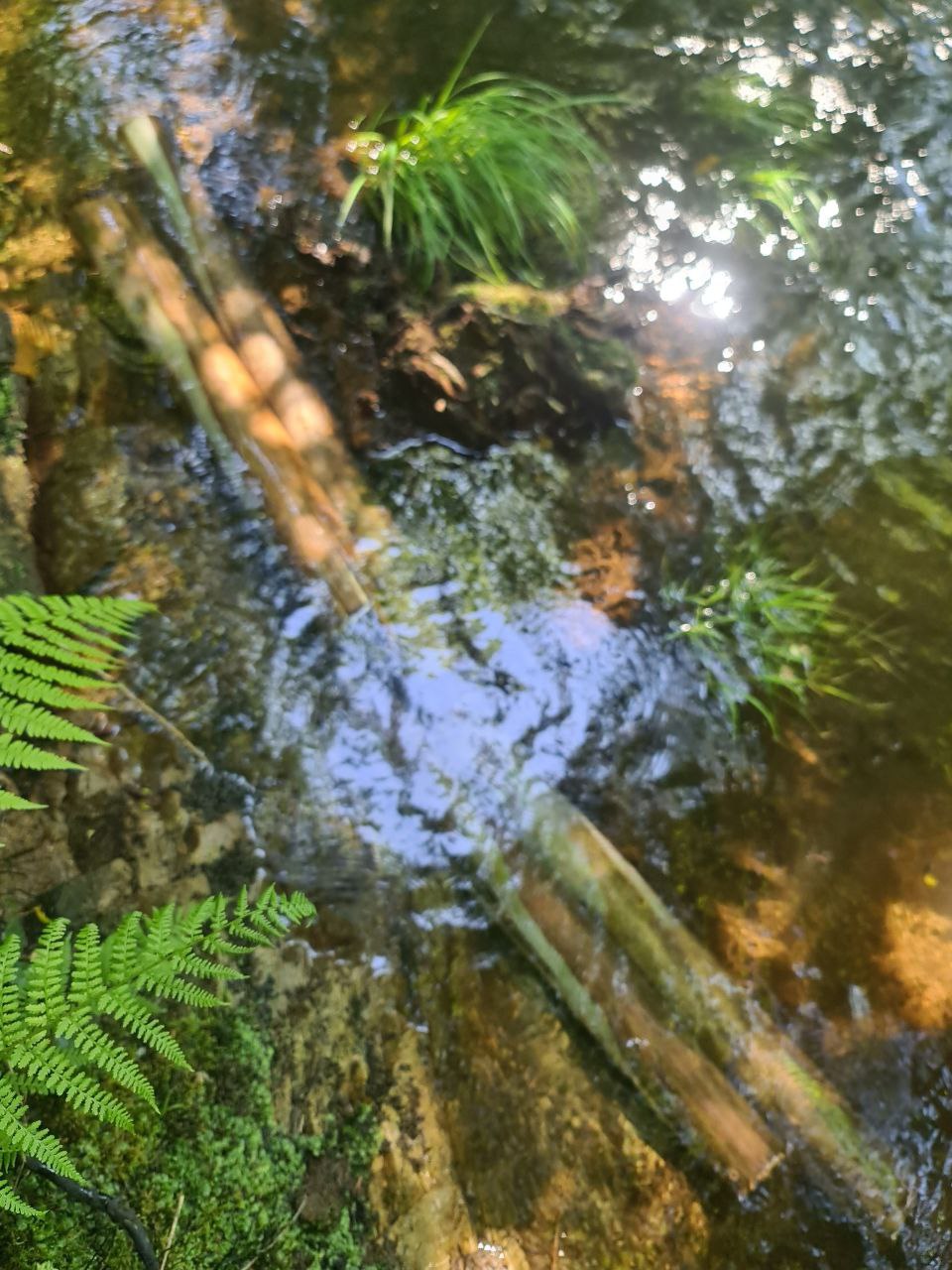
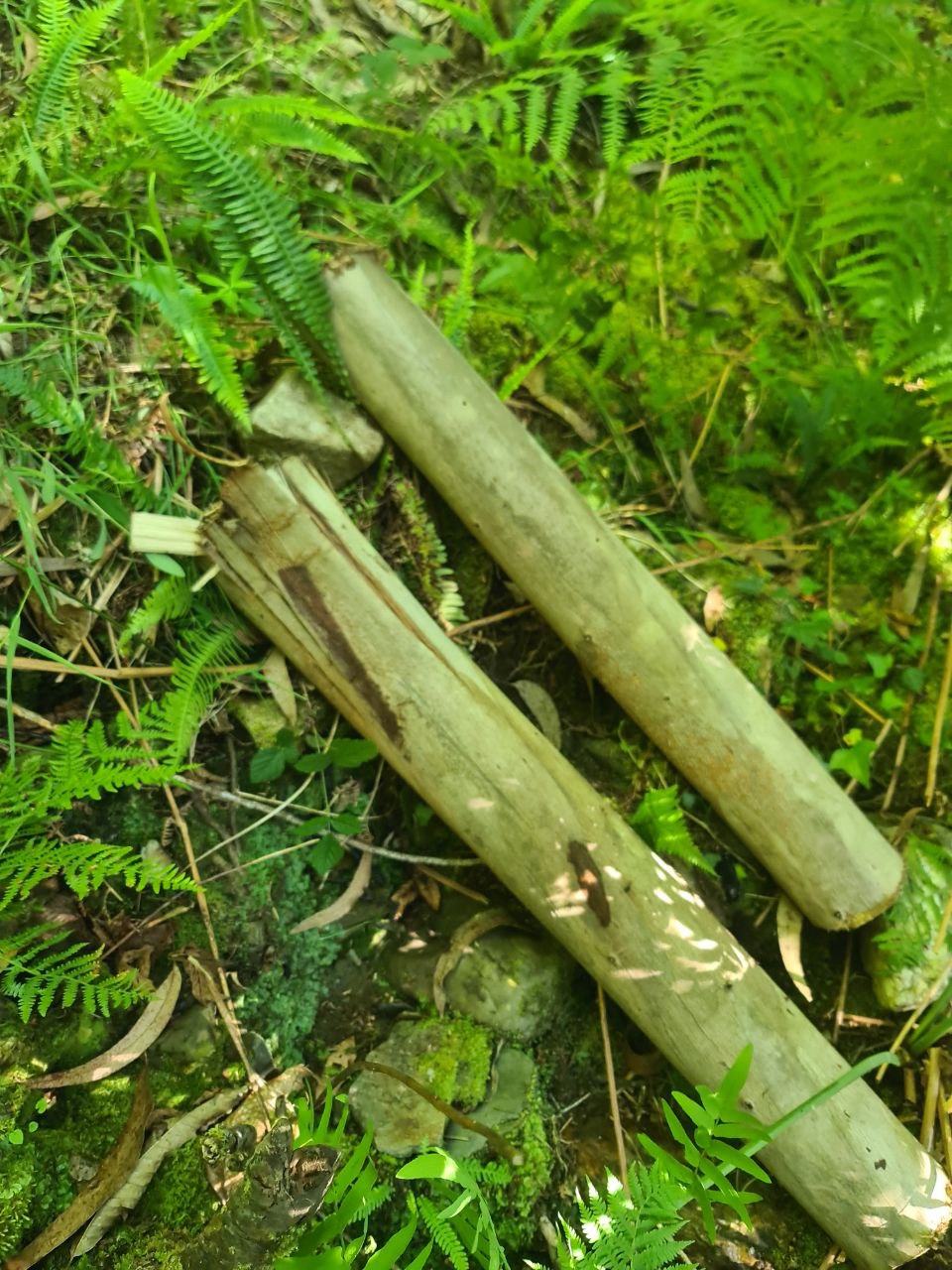
The intention is to run this as citizen science rather than private experiment: repeated trials across summer events, data collected in a shared format, and results published so that anyone cutting eucalyptus in Galicia can use them. If the technique works, felled eucalyptus stops being a disposal problem and becomes a crop — which changes the economics of removing it.
Related: mycorrhizal fungi are the other half of this. The Society for the Protection of Underground Networks maps underground fungal networks worldwide and runs sampling expeditions with local partners; the association has looked at applying to have this land sampled: https://www.spun.earth/expeditions
Grazing, clearing and rewilding: an open question
This is the live disagreement on the land, and it is worth stating plainly rather than tidying away, because anyone joining the association will meet it.
A neighbouring farmer has grazed cattle here before, on the land before the bridge and around the houses, using mobile electric fencing. Grazing is cheap, continuous maintenance, and rotating animals is a well-established way of keeping ground open without machinery.
The difficulty is that the land as it stands is not what the animals want to eat. Making it ready would mean clearing first — and there the arguments diverge.
The case for clearing and grazing. Ground that is not used becomes inaccessible. Trees planted in previous years are being overgrown by scrub. There are ticks in quantity, rodents arrive with the cold, and dry spells create a fire risk where people light fires. Left alone, the thicket expands and the problem compounds: every year of delay makes the eventual intervention larger. A tractor pass is roughly an hour's work; the same clearing by brushcutter is closer to half a week. Grazing afterwards keeps it in hand at almost no cost, while parts of the land — around and behind the church — stay deliberately wild.
The case against heavy machinery. The land is mostly grass, herbs and wildflowers with patches of fern, not dense bramble, and ferns around young trees can be cleared by hand without much difficulty. Grass fires burn fast and die out. Rodents are ordinary countryside inhabitants, not a pest to be eliminated, and a great deal of life shares this ground: part of stewarding it is doing as little harm as the work allows and, where possible, adding to it. A tractor pass is fast, and speed is rarely what land needs. Strimming, done by people, achieves access without destroying soil structure — a few days' work being a small price for the health of the soil.
Where it stands. At the general assembly of July 2026 the question was judged too big to settle in a single meeting, and an interim decision was taken: the land will be cleared and cows put to pasture. The larger question remains open — whether the long-term direction here is an agroforestry system, a grazed meadow, or a deliberate rewilding. Nobody wants to abandon the land by default; everyone would rather it were decided with a concept than by drift. There is one further hope attached to it: that documenting what is done to the land, season by season, will give the continuity that a changing group of residents has never quite had. This page is part of that attempt. If you have a view, or you did work here that is not recorded, add it.
This is on the agenda for a wider conversation. If you have a view, that conversation is the place for it.
Fire
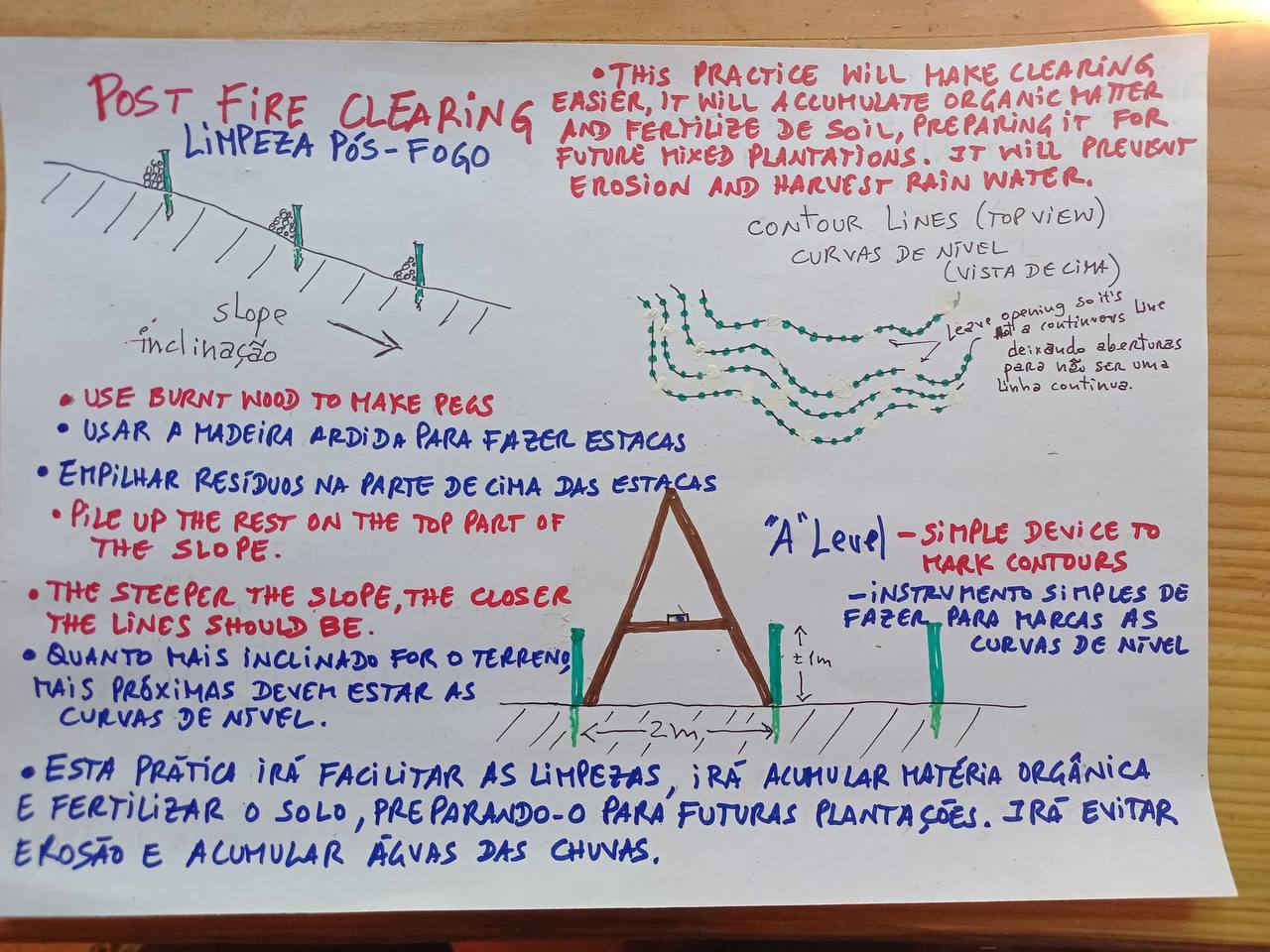
Fire is the background condition of land care in Galicia, not an occasional emergency. In August 2025 members shared a set of post-fire techniques learned from peers working on the Mount of Oaks, and the principles are worth recording even where the drawings are not ours to publish:
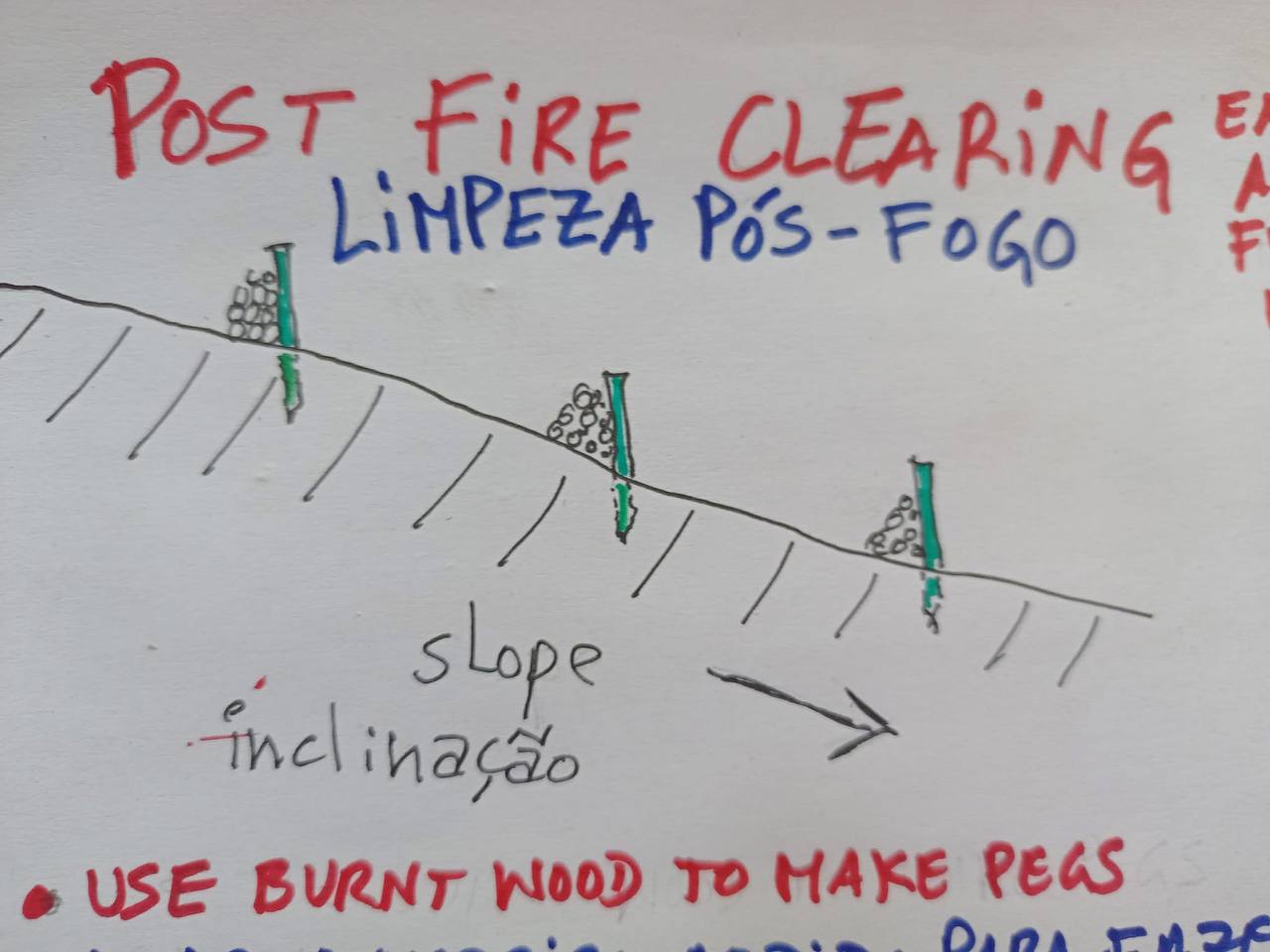
- Burnt wood is a resource, not rubbish: charred stems make the pegs and stakes for the work that follows.
- Debris is piled on the upslope side of stakes laid along contour lines, so that rain is slowed and organic matter accumulates instead of washing away.
- The lines are left with gaps rather than run continuous, so water spreads rather than channelling.
- The steeper the slope, the closer together the lines must be.
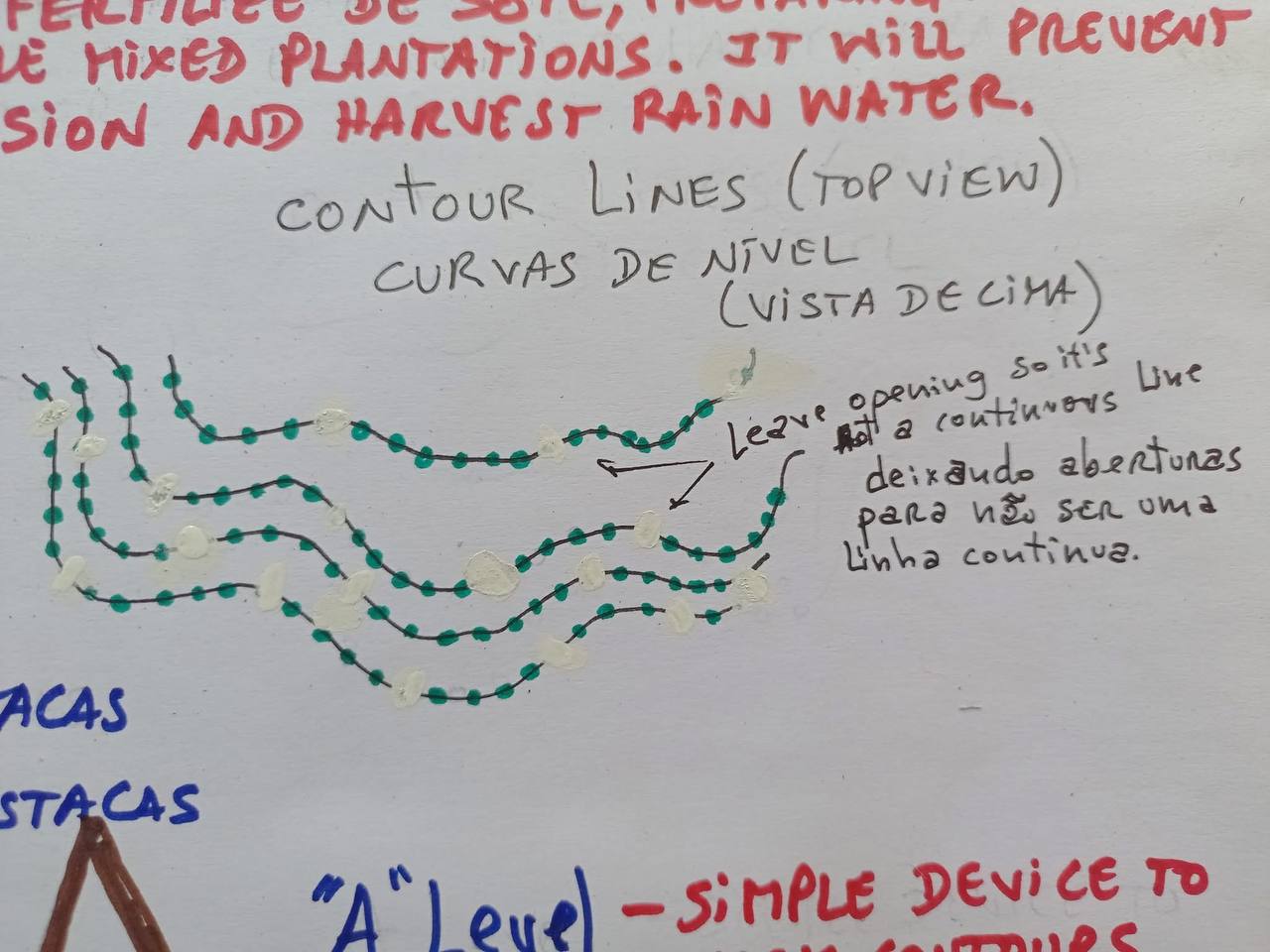
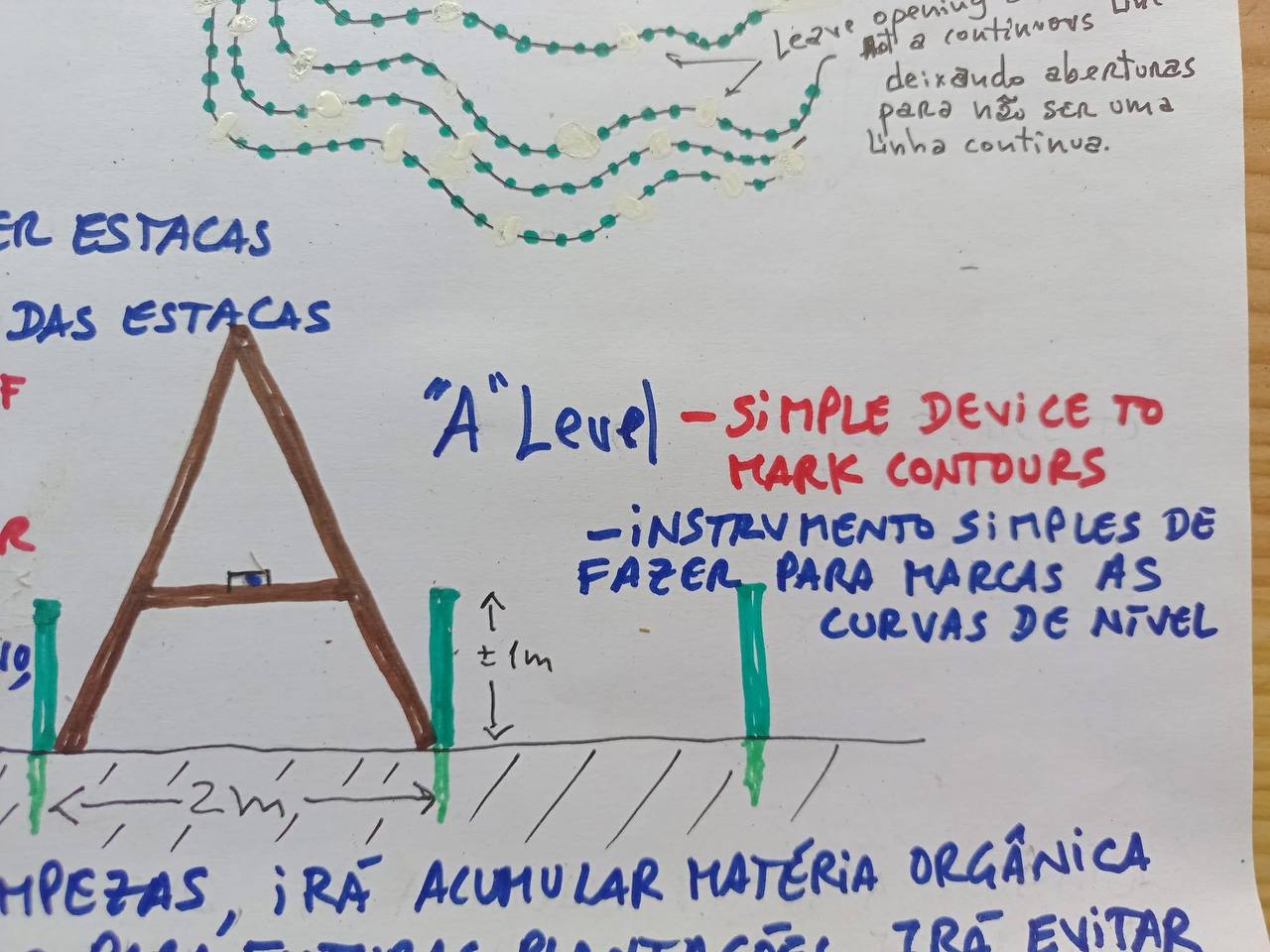
- Contours can be marked with an "A" level — two legs about two metres apart and a crossbar, with a weight hanging from the apex. It costs nothing and it is accurate enough.
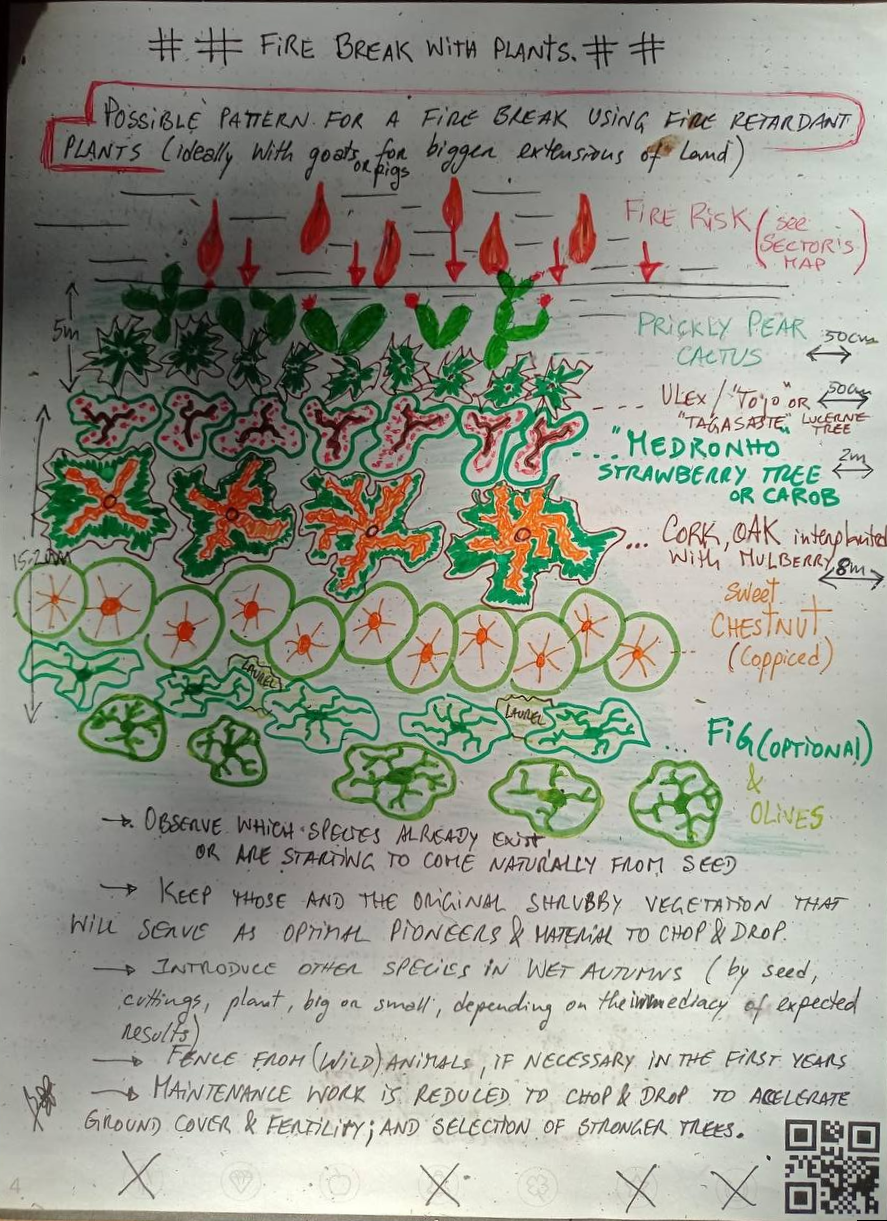
- For a firebreak, fire-retardant and fleshy species are placed along the exposed edge, keeping whatever pioneer vegetation is already coming up naturally, and maintenance is reduced to chop-and-drop as ground cover establishes.
Neighbours and networks
The land is not worked in isolation, and most of what we know arrived through somebody else's practice.
- Proxecto Dispersor — agroforestry design, planting and tools, Galicia: https://projectodispersor.com and https://www.instagram.com/projectodispersor/
- Brigadas Deseucaliptizadoras / Verdegaia — collective removal of invasive species, roga and albaroque: https://verdegaia.org/brigadas/
- Plataforma Ulloa Viva — the campaign against the Altri plant: https://gl.goteo.org/project/altri-non-por-un-rural-galego-vivo-alegre-digno-e-
- SPUN — mapping and protecting underground fungal networks: https://www.spun.earth
- Traditional Dream Factory, Alentejo, Portugal — a regenerative community in the OASA network, whose volunteer programme covers mushroom growing, market gardening, construction and land care. We share text and practice with them: https://www.traditionaldreamfactory.com/volunteer
Helping
Land work here happens in concentrated bursts, and those are the best moments to arrive: there is always more to do than hands to do it, and a few days of several people working together moves things that individuals cannot.
Useful things to bring: work gloves, boots that cope with wet ground, and a willingness to be told where things are. Useful things to know: which plants you can identify, whether you have used a brushcutter or a chainsaw before, and whether you would rather work with soil, wood or water.
If you want to propose something for the land — a planting, a trial, an intervention — bring it as a proposal rather than a fait accompli. The disagreement described above is the reason: this ground is held in common, and decisions about it are made together.